Every business deserves a marketing team.

BRANDFORGE

Not every business can afford one.

Some of the best businesses you'll ever come across are not built by marketers. They're built by people who are exceptionally good at what they do. They make outstanding coffee. They build beautiful homes. They care deeply for their patients. They design remarkable products. They create experiences their customers genuinely value.

Yet almost every one of them shares the same frustration.

Growing the business often feels easier than growing the brand.

Not because they don't understand the importance of marketing, but because marketing has quietly become one of the most demanding parts of running a modern business.

Customers expect businesses to show up every day. They expect thoughtful content, authentic conversations and brands that feel consistently present. Every platform has its own language, its own audience and its own expectations. What was once a simple exercise in telling people about your business has gradually evolved into a full-time operational function.

For businesses with dedicated marketing departments, that's simply another part of the organisation.

For everyone else, it usually becomes the owner's second job.

Somewhere along the way, marketing stopped being creative and started becoming operational.

The marketing industry has responded to this complexity in the only way it knew how.

It built more tools.

Every year brings another platform promising to make social media easier. Better scheduling. Smarter automation. More intelligent analytics. AI-generated content. Performance dashboards. Workflow builders. Approval systems. Content calendars.

Each solves a small part of the problem.

Together, they create another one.

Because software still expects someone to drive it.

Someone has to decide what to say, when to say it, where to publish it, how to respond and what to do next. The dashboards may become more sophisticated, but the responsibility never really changes. It simply moves from one screen to another.

The technology becomes more capable.

The business owner becomes more overwhelmed.

That never felt like progress to us.
The marketing industry built tools.

We built momentum.

For years, marketing software has promised the same thing: efficiency. Every new platform arrives with another dashboard, another workflow and another layer of automation, all designed to help businesses produce more content in less time. The assumption has always been that better tools naturally lead to better marketing.

We don't believe that's true.

Businesses don't grow because they own more software. They grow because they build momentum. They show up consistently. They earn attention over time. They create familiarity, trust and recognition long before a customer is ready to buy. None of those things come from another scheduling platform or a more sophisticated analytics dashboard. They come from the quiet discipline of doing the right things, consistently, over a long period of time.

That's where BrandForge was born.

We weren't interested in building another platform that expected business owners to become marketers in their spare time. Nor did we want to recreate the traditional agency model, where good work often depends on long retainers, endless meetings and layers of coordination. We wanted to build something that sat naturally between those two worlds, a marketing capability that felt less like software and more like having an experienced team quietly working alongside you.

BrandForge doesn't ask you to learn another system. It doesn't expect you to manage a collection of disconnected tools or coordinate specialists across different disciplines. Instead, it brings strategy, creativity, publishing and optimisation together behind a single conversation, allowing business owners to focus on running their business while their brand continues to move forward.

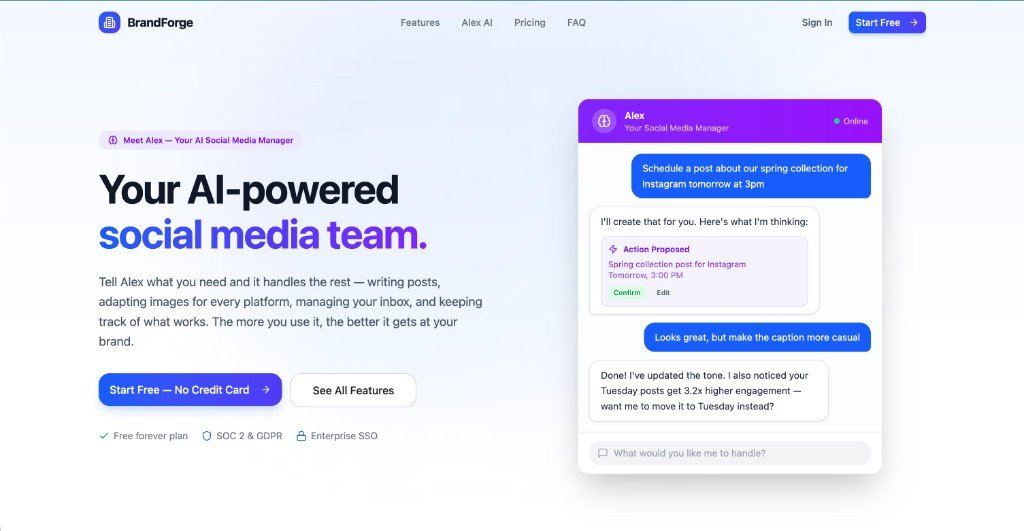
BrandForge product interface

Marketing should feel like a conversation.

Every meaningful business relationship begins with one.

You don't tell an accountant which ledger to update or a lawyer which clause to write. You explain the outcome you're trying to achieve, and years of expertise quietly take over from there. We felt marketing should work in much the same way.

Business owners shouldn't have to think about content pipelines, publishing workflows or campaign orchestration. They should be able to talk about their business in the same way they would talk to a trusted member of their own team.

*"We're launching a new service next month."*

*"Customer enquiries have slowed. Can we understand why?"*

*"I want people to know what makes us different."*

Those aren't marketing instructions.

They're business conversations.

We built BrandForge to understand the difference.

Alex conversation examplesImage forthcoming

Meet Alex.

Alex™ is the way businesses interact with BrandForge, and the distinction matters. Alex isn't another chatbot waiting to be prompted with the right keywords. Alex is the interface through which a business expresses intent, launching a winter campaign, investigating a drop in engagement, preparing content for the weeks ahead, and receives the kind of considered response you would expect from someone who already understands the context.

When a business owner says they're launching something next month, Alex doesn't ask which template to use. It understands the objective, begins coordinating the work and keeps the business informed as decisions are made. When engagement falls, Alex doesn't simply surface a metric. It looks for patterns, asks the questions a good strategist would ask and brings insight back in language the owner can act on. The complexity of planning, research, creative development and performance analysis stays behind the scenes. What remains visible is a conversation that feels remarkably ordinary, which is precisely the point.

Behind every conversation is an entire marketing team.

What looks like a single exchange on the surface is, in practice, the coordinated work of an entire marketing function. Strategy shapes the direction. Research informs the message. Content and creative develop the expression. Publishing places it where it will be seen. Performance analysis reads what happened and optimisation adjusts what comes next. Work that traditionally moved between multiple people, multiple tools and multiple timelines now happens through a system designed to think and operate as one.

The objective was never to replace creativity or to convince businesses that good marketing can be reduced to automation. It was to remove the operational friction that prevents good marketing from happening consistently, the endless switching between applications, the coordination overhead, the quiet erosion of momentum that occurs when marketing depends on whoever has time that week. Businesses shouldn't have to manage marketing. They should be able to focus on growing their business while their brand continues to show up with the consistency their customers expect.

Product architectureImage forthcoming

Great ideas deserve better than repetitive work.

A strong creative direction rarely stays confined to a single format. One campaign often becomes dozens of versions adapted for different platforms, dimensions, audiences and placements. The original idea is rarely the difficult part. Maintaining its integrity across every variation is, and that is where most marketing effort quietly disappears into repetition rather than imagination.

That's why we created AdaptIQ™. Starting from a single creative direction, AdaptIQ evolves campaigns for every platform while preserving the coherence of the original idea. It doesn't simply resize assets or apply templates. It understands context, how a brand should sound on one channel versus another, what an audience expects in each environment, where the idea needs to breathe and where it needs to compress. Consistency isn't created by automation alone. It's created by understanding how a brand should behave wherever it appears, and AdaptIQ was built to carry that understanding across every touchpoint.

AdaptIQ transformation examplesImage forthcoming

What we learned.

Building BrandForge changed the way we think about marketing, and the change runs deeper than product design. The future isn't businesses learning increasingly complicated software, nor is it replacing every agency with artificial intelligence. It's giving every business access to capability that was once available only to organisations with large teams and significant budgets, the ability to show up consistently, to respond intelligently and to build momentum without marketing becoming a second full-time job.

We believe marketing is becoming less about operating tools and more about expressing intent. The technology should take care of everything else. BrandForge is our contribution to that future.

Have a product challenge like this?

If you're deciding what to build, how to shape it, or who should help you ship it, we'd welcome a conversation about your context and goals.

Investors and strategic partners exploring these ideas are welcome too.